
It picks the weight.
You just lift it.
No badges, no beginner mode. Autoregulated loads and weekly volume per muscle — and the rules it decides by are yours to tune.
GETSIXPACK
Built for lifters, not beginners
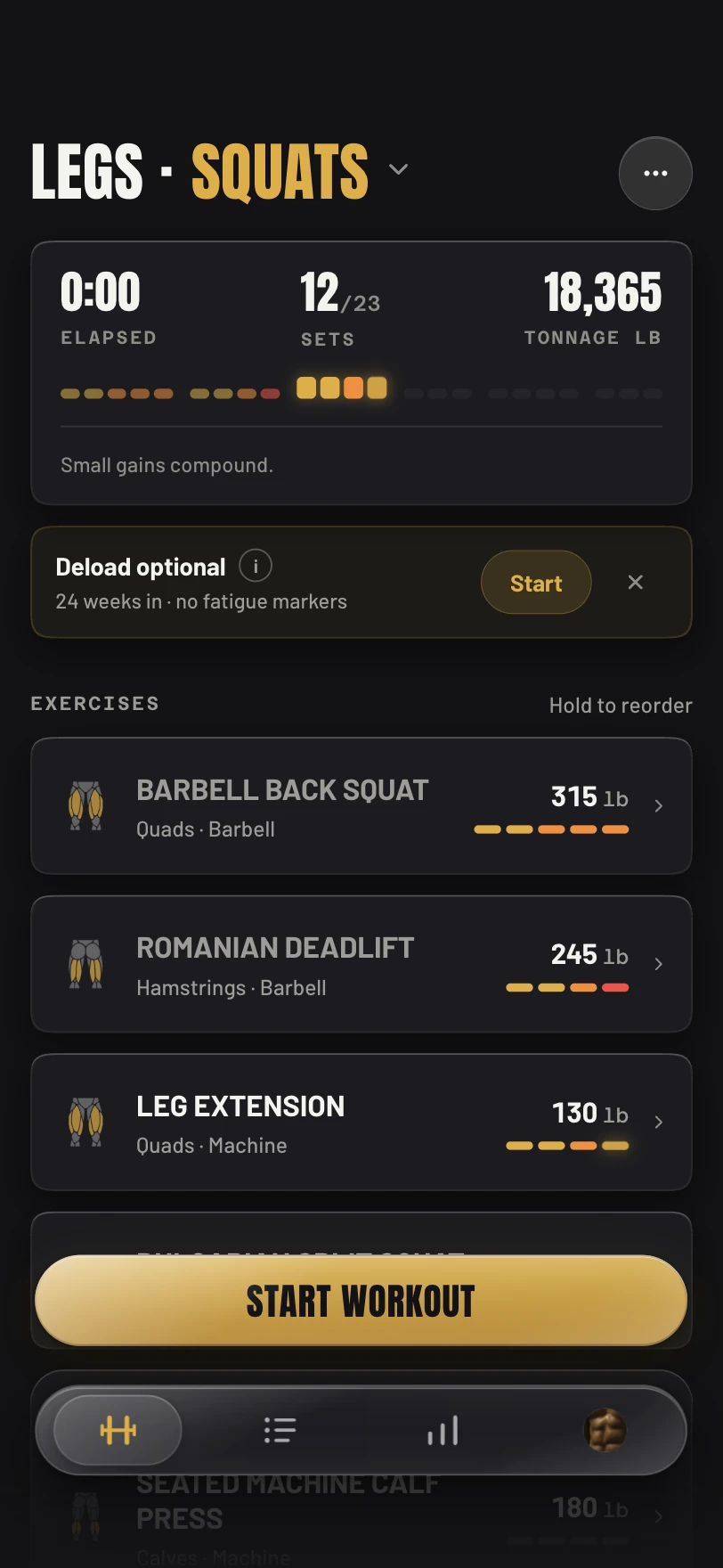
Your log decides what you lift today
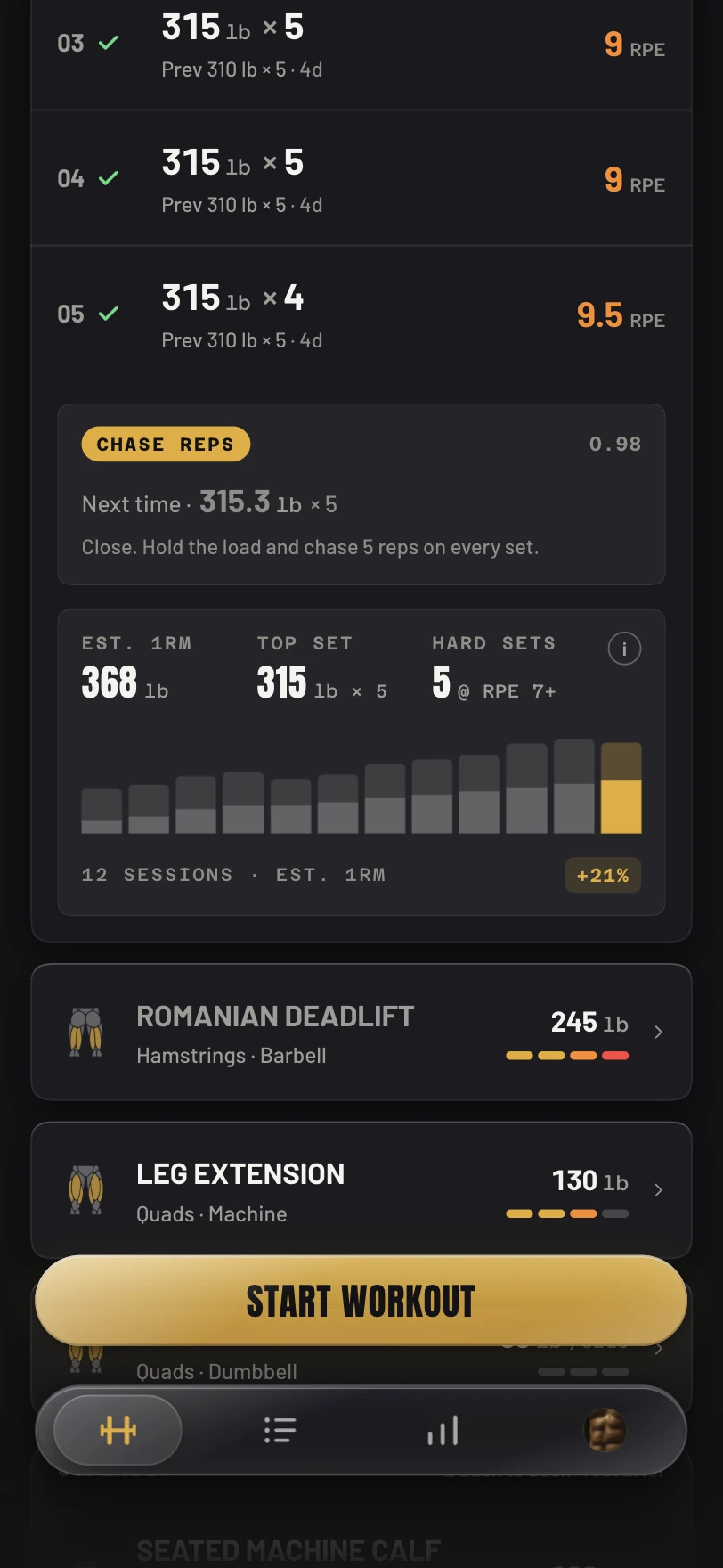
- Calls your next loadScored against your rep range. The gate is the last set's RIR.
- Counts the week, per muscleHard sets against MEV, MAV and MRV. Zeros included.
- Backs off before you stallTwo fatigue markers in the log, not a date on a calendar.

Why it's different
Logging was never the hard part
You already have four years of sets in something. It has never once told you what to do with them.
The coach
A coach you can argue with
Nothing goes up unless every working set hit the top of the range and the last one came in at 2 RIR or better. A high score on its own adds nothing.
And it hands you the arithmetic. Read it, disagree with it, log the set you were going to log anyway. It does not sulk, and it does not hide the number it used.
Readiness is the one term you can skip. Skipped, it returns 1.00: it can hold an increase back, never push one through, and never on its own.

Bring your own rotation
Four minutes to set it up. It calls your next load after one session.
On the floor
Ninety seconds. One hand.
The other one is on a bar, and the phone is a metre away on the bench. Everything you touch mid-set clears 44px.
Effort starts empty, because pre-filling it means people log it by reflex. RPE 10 is zero reps left, not failure, and a miss is its own mark — calling 10 “fail” is how you end up with a log full of 9s and a coach quietly under-loading you for a month.

Rest
Your rest timer has been lying to you
Lock the phone and a timer that counts its own ticks stops counting. You come back to a clock reading 1:12 and take a two-minute rest thinking it was ninety seconds.
This one holds an instant and subtracts. Sixty ticks and one number, readable with the phone propped against a plate stack, and never modal — rest is the only window you get to fix the set you just botched.

Volume
When did you last train calves?
Weekly hard sets per muscle against MEV, MAV and MRV. Every muscle listed, zeros included, because a muscle you have not trained cannot show up in a count of what you trained.
Then it names the lift that takes the extra set: something already climbing, never one it is backing off, ties broken toward whatever carries the fewest sets.

How it works
The whole coach is three moves
Hit the top of the range
Same weight every session until every set gets there. A compound sits at 6 to 10.
9, 8, 8 reps → not there yetAnd the last one has to be hard
Two reps left in you at most. If five more were in there, it does not count.
10, 10, 10 reps → and it was a fightThen it adds one notch
The smallest jump the equipment allows, never a percentage. Then you climb again.
+5 lb → back to about 6 repsDetails
Nine things you're currently doing in your head
- Units per exercise
- kg rack, lb dumbbells. The choice follows the movement.
- Plate math, per side
- Real plates for that unit. Tells you when you are 5 lb short.
- Sets counted three ways
- Warmups nothing. Working sets everything. Drops, volume only.
- e1RM that names its formula
- Epley, Brzycki or Lombardi. They disagree by 8%. Compounds only.
- Rest lives on the exercise
- 3:30 after squats. 1:30 after leg extensions. Set once.
- It never punishes its own call
- Reps drop when load goes up. It checks the weight before it reads the reps.
- Offline by default
- Writes queue on the device and return instantly.
- Per-side loading, handled
- It already knows which lifts double their volume.
- Everything recomputes
- Flip to kg and four years of history follow.
Deliberately missing
Built to be put away
- No streaks, badges, rings or XP.
- No confetti for opening the app.
- No feed, no followers, no leaderboard.
- No ads.
- No tutorial explaining what RIR is.
- No verdict without the arithmetic under it.
Compared
Every other app makes you pick one
Logs record everything and decide nothing. The apps that decide take your exercise selection with them. This one takes the decision and leaves the programme alone — and it is the only column here with a tick in both of the first two rows.
| GETSIXPACK Coached log | Hevy Log | Strong Log | RP Hypertrophy Coach | Fitbod Generator | Freeletics Generator | |
|---|---|---|---|---|---|---|
| You bring the programme your split, your exercises, your order | ✓ | ✓ | ✓ | In blocks | – | – |
| It calls the load for today a number on the bar before you touch it | ✓ | – | – | ✓ | ✓ | ✓ |
| Effort gates the increase no jump unless the last set came in at 2 RIR or closer | ✓ | Logged only | Logged only | ✓ | – | – |
| Weekly sets per muscle, scored against MEV / MAV / MRV, not just charted | ✓ | Charts only | – | ✓ | – | – |
| Deload called by fatigue, not the date two markers have to stack; a due date only prompts | ✓ | – | – | Scheduled | – | – |
| Units and increments per exercise a kg rack next to lb dumbbells, real stack sizes | ✓ | – | – | – | – | – |
| Shows the rule behind the number the arithmetic, per lift, in the app | ✓ | – | – | – | – | – |
| Names the 1RM formula it used Epley and Brzycki disagree by about 8% | ✓ | Not named | Not named | – | – | – |
| The whole method is published the cascade and the constants, in public | ✓ | – | – | ✓ | – | – |
| No streaks, badges or feed nothing built to keep you in the app | ✓ | – | ✓ | ✓ | – | – |
Checked August 2026 against each app’s own published features. Product names belong to their owners; nothing here is affiliated with any of them, and every row is meant to be checkable by anyone who owns both.
Writing
Bro science, checked against the papers
 Training The Six Ways a Cut Quietly Eats Your Muscle
  You Started Cutting and the Scale Went Up. Here Is Why A 500 calorie deficit removes about 65 grams of fat a day. Everything else the scale weighs moves by more than that — here is what, and how much.


It does the math between your sets
Questions
Twelve things people ask before installing
Who is this for?
Lifters who already log every set and want something done with them. It assumes you know what a working set, a rep range and RIR are, and it never explains them to you.
Is there an Android version?
Not yet — iPhone only. It is a native iOS app rather than a wrapped web page: the rest timer runs on the Dynamic Island and keeps time with the app closed, which is the kind of thing that has to be built twice rather than ported. Android is planned, and the weekly email is where it gets announced.
Is this built for men?
It is built around male muscle anatomy: the muscle-group illustrations are drawn on a male figure, and the weekly volume landmarks come from a research base that is overwhelmingly male lifters. Everything else is the same for everyone — it never asks your sex, and load, reps, rest and progression are one piece of arithmetic. It works the same way for women; it simply does not model anything specific to them, and there is no cycle tracking.
Does it write my training programme?
No. You bring the rotation — the workouts, in the order you run them. It decides the load and reads the reps, session to session, inside the programme you already believe in.
How does it decide the weight?
Double progression with a binding gate: nothing goes up until every working set hits the top of the rep range and the last one comes in at 2 RIR or closer. Then it adds one equipment increment — the smallest jump the equipment allows, never a percentage.
The whole algorithm →Do I have to log effort on every set?
No. Effort is collected on straight working sets only, never on a warm-up or a drop, and leaving it blank is allowed — an unrated last set is read as a hard one, so it can never trigger a load cut on its own.
Can I set my own rep ranges, rest and increments?
Per exercise, all three. Leave any of them blank and the movement takes its class default. The increments matter more than people expect: a pinned 10 lb stack and a barbell with microplates are different grids, not different preferences.
Does it work in kilograms or pounds?
Both, chosen per exercise, because gyms are mixed — a kg rack next to lb dumbbells. Everything is stored in kilograms, so switching a lift changes what you read and never what was recorded.
Does it work with no signal?
Yes. Writes queue on the device and return instantly, then sync when they can. Nothing waits on a request to consider a set logged, which is the only design that survives a gym basement.
What happens if I take two weeks off?
The prescription waiting for you is the one written the day you last trained, so it is adjusted when you open it. It takes two reasons — a real calendar gap and a gap well past that lift’s own cadence — because on a long rotation ten days between outings is simply normal.
When does it tell me to deload?
When two fatigue markers stack in the log, and at most one of them can be the calendar. A deload placed mid-block purely because it was due produced no growth benefit and measurably cost strength, so a due date suggests one and never announces one.
What happens to my training data?
It is your log and your email address, and nobody else sees either. No ads, no advertising pixel, no feed, nothing sold. Ask for a copy or a deletion and it gets done.
What is stored, in full →Every Sunday
One study, one thing to change
What the research actually says about volume, rest and progression, cut down to the one change worth making next block — and a release note when there is genuinely one.